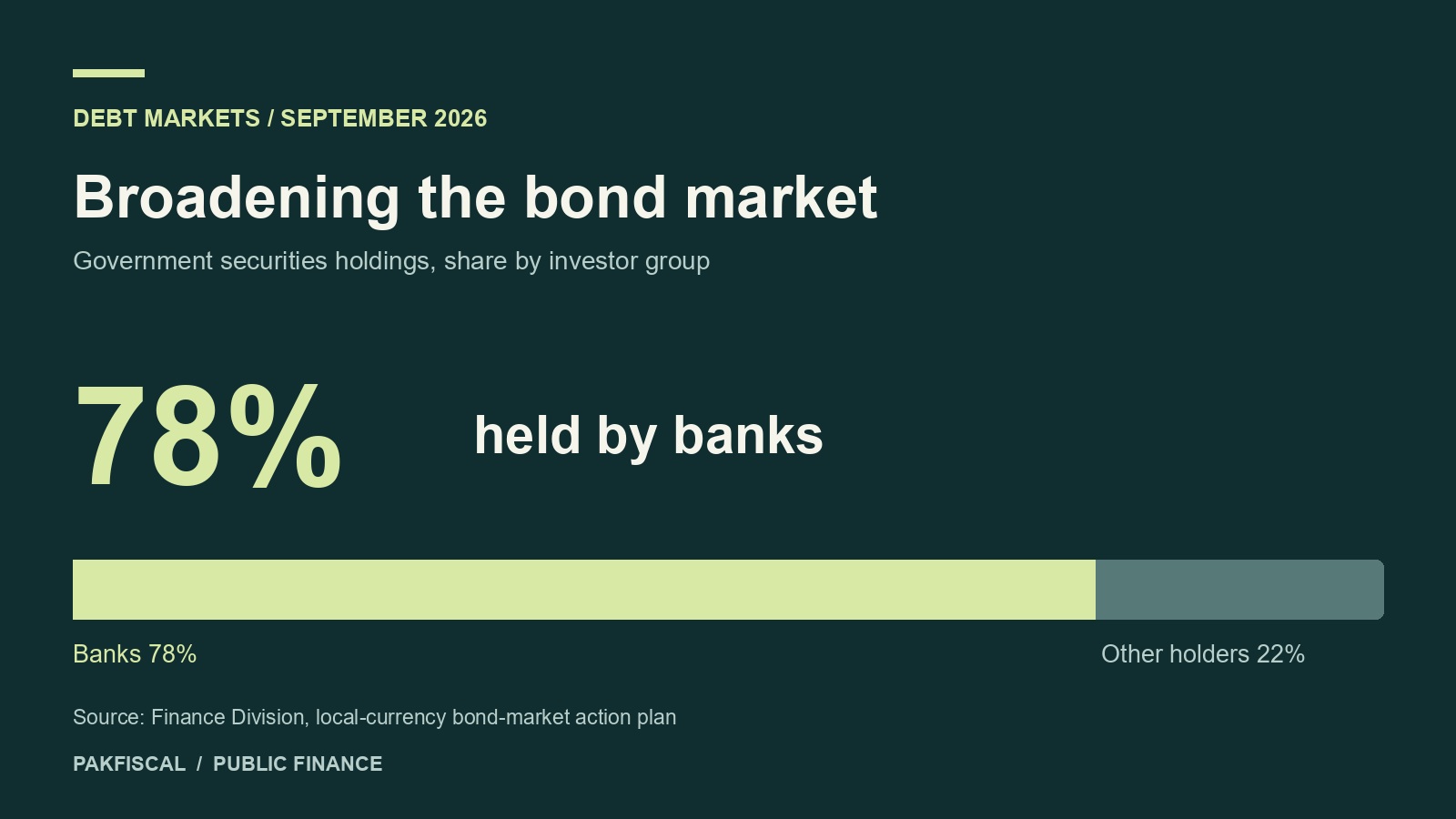
Pakistan’s Finance Division has published a September 2026 action plan to develop the local-currency bond market. It identifies banks’ 78% share of government-securities holdings as part of a concentrated investor base and sets out reforms intended to broaden participation and improve trading.
A financing market needs buyers and trading
A government can place securities successfully at auction without those securities becoming easy to trade afterwards. That distinction matters: investors considering a longer commitment also need to understand how readily they could sell before maturity.
A broader investor base could reduce dependence on a single class of buyers, but access alone does not create demand. Investors still weigh returns, maturity, transaction costs and the ability to exit. Reform therefore needs to address the functioning of the market as well as the channels through which people enter it.
What the plan proposes
The programme includes more predictable issuance, stronger secondary-market trading, wider retail and institutional participation, and changes to infrastructure and legal or tax arrangements. Retail channels named include InvestPak, brokers, mutual funds and government-bond exchange-traded funds.
It also proposes reviewing withholding on coupon and discount income and the tax treatment of securities held through collective investment schemes. These are planned reforms, not evidence that the tax rules have already changed.
How to judge progress
The plan schedules a steering committee by November 2026 and an implementation roadmap by December. Wider reforms extend through September 2028 and beyond, with public progress reporting every six months.
For public-finance readers, implementation evidence will be more informative than the ambition of the announcement. Useful questions include whether auction information becomes more consistent, whether investors can observe actual trades, and whether participation broadens beyond the established bank audience.
Lower financing costs are an objective, not a guaranteed result. Market reforms cannot remove the influence of fiscal needs, inflation expectations or investors’ assessment of risk. Their potential contribution is to make the process of financing and trading more dependable.
This adds a different dimension to Pakistan’s debt debate. Alongside the size of the debt stock and the amount falling due, the structure of the market determines who can fund the government and under what conditions.
Official source and related reading
PakFiscal: Maturing debt makes up most of Pakistan’s FY2027 financing need.