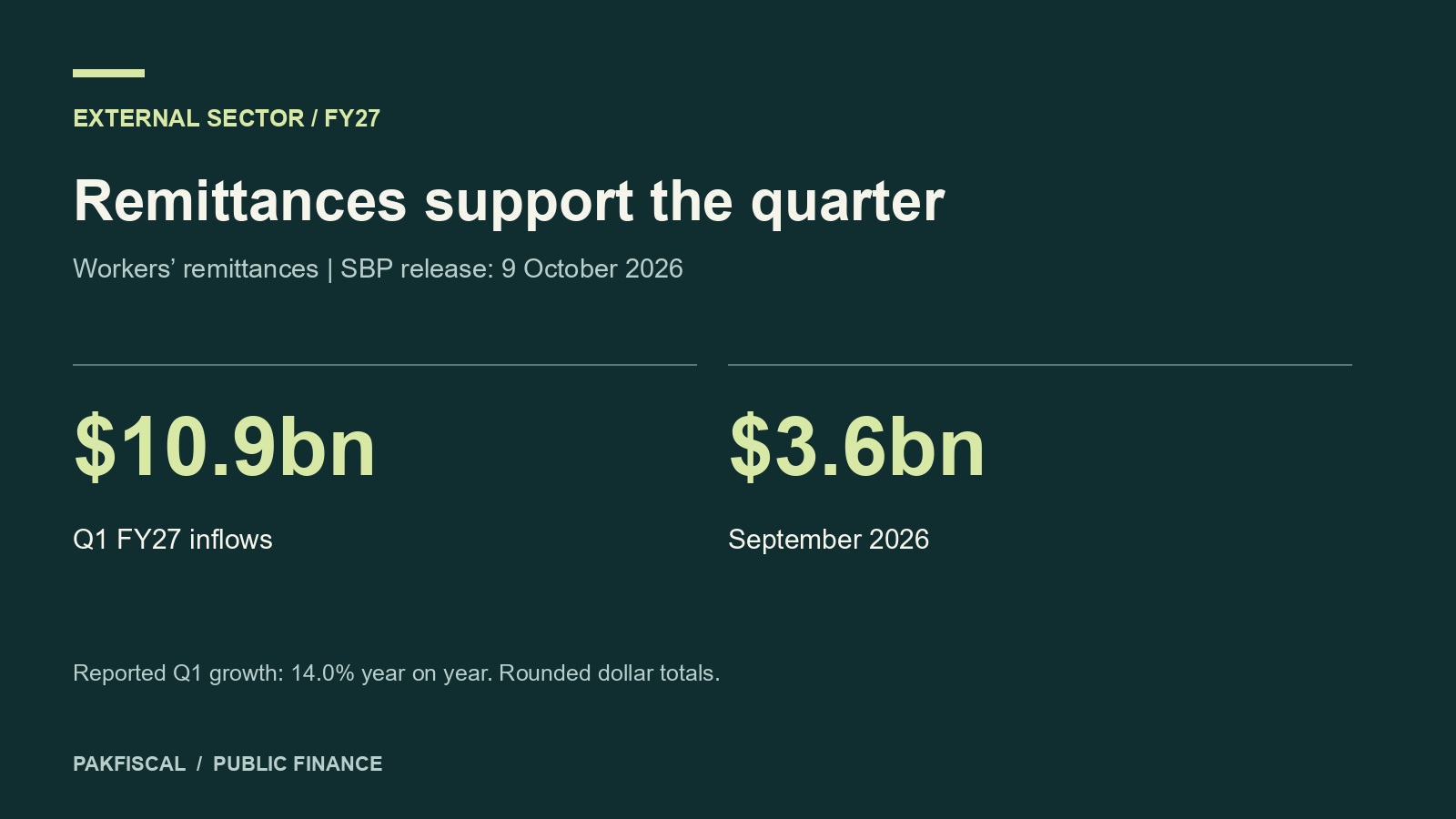
Pakistan received US$10.9 billion in workers’ remittances during the first quarter of FY27, according to the State Bank of Pakistan’s 9 October release. Overseas workers continue to provide an important source of foreign currency, with the quarterly total up 14.0 percent from a year earlier.
The monthly and quarterly readings differ
September 2026 inflows were US$3.6 billion, an increase of 12.7 percent year on year but a decline of 1.9 percent from August. The comparison illustrates why a weaker month does not necessarily overturn a stronger quarter. Each percentage answers a different question.
| Measure | Reported result |
|---|---|
| September 2026 inflows | US$3.6 billion |
| September year-on-year change | +12.7% |
| September month-on-month change | −1.9% |
| Q1 FY27 inflows | US$10.9 billion |
| Q1 year-on-year change | +14.0% |
SBP identifies Saudi Arabia, the United Arab Emirates, the United Kingdom and the United States as the main September corridors. Its published quarterly totals are rounded; the reported growth rate should be used rather than recalculated from rounded dollar amounts.
Household income and the public finances are different accounts
A remittance is a transfer to its recipient. It can help a household meet expenses, accumulate savings or finance an investment. The foreign exchange passing through formal channels can also support the wider balance of payments. These are related economic effects, but they should not be presented as a direct addition to federal tax receipts.
The fiscal question is therefore indirect. External financing conditions can influence the environment in which the government services foreign-currency obligations. Household spending may also affect economic activity. Neither link justifies treating the full remittance inflow as money available for budget expenditure.
What to watch after the first quarter
The useful next comparison is whether inflows remain strong across subsequent months, alongside exports, imports and external payments. A single monthly dip is insufficient to establish a reversal. Equally, one strong quarter should not be mechanically multiplied into a full-year forecast. The timing and persistence of inflows matter as much as the headline total.
Sources and reporting basis
SBP: Workers’ remittances for September 2026, released 9 October
Official information checked on 18 October 2026. Interpretation is PakFiscal’s; reporting periods and policy targets are identified separately from publication dates.