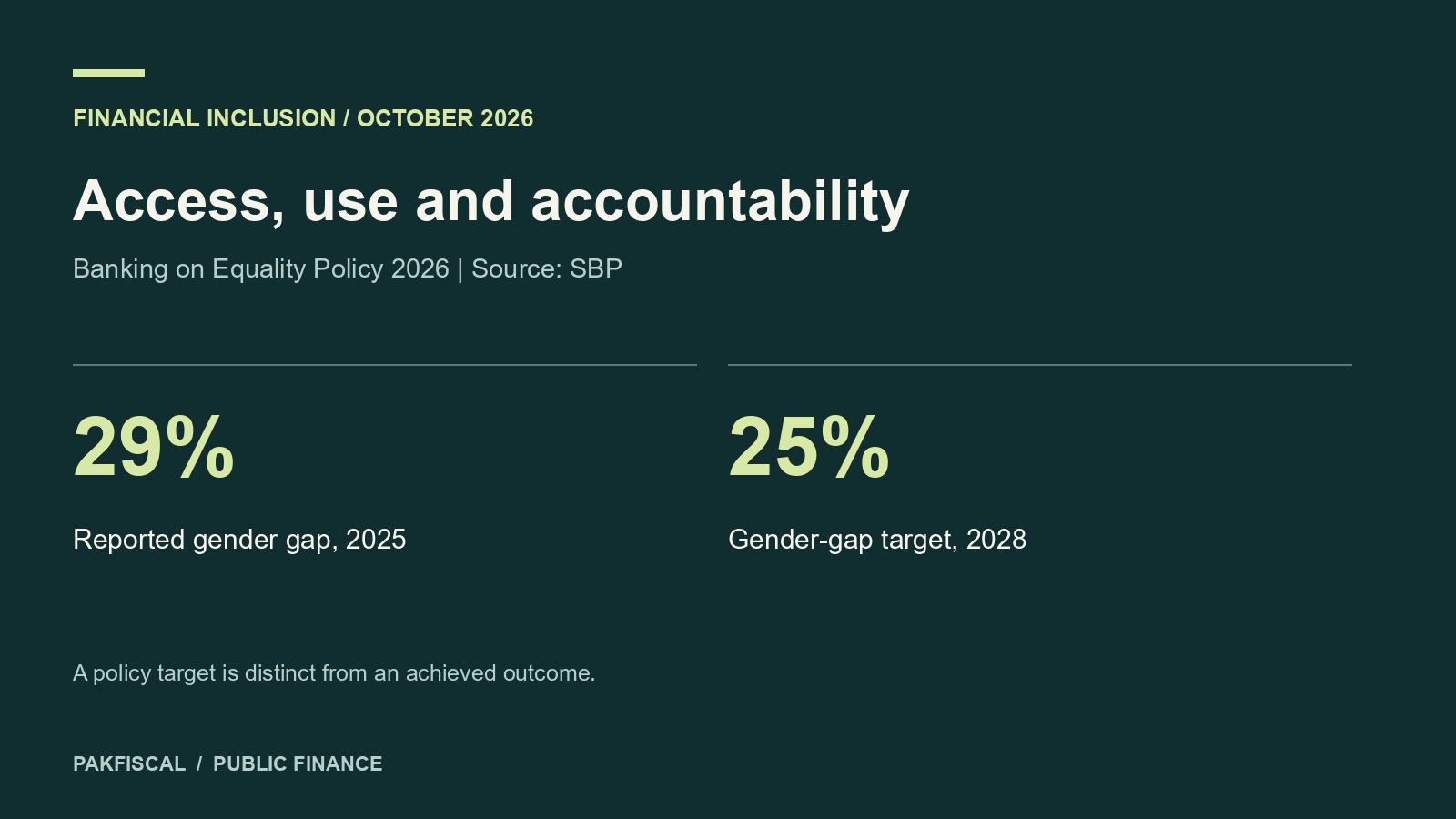
The State Bank of Pakistan launched its second Banking on Equality policy on 13 October 2026. The announcement reports that the financial-inclusion gender gap narrowed from 39 percent in 2021 to 29 percent in 2025, while setting out further action to improve women’s access to finance.
The next stage reaches beyond opening accounts
The launch release describes priorities covering women’s representation in banking, digital services, entrepreneurship and gender-disaggregated monitoring. SBP says implementation will involve quarterly reporting and mystery-shopping exercises. These are planned accountability mechanisms; their inclusion in a policy is not evidence that every intended outcome has already been achieved.
The accompanying policy document adds operational detail: simplified digital business accounts for women, entrepreneurship hubs and alternative approaches to credit assessment. It links the programme to a national objective of reducing the gender gap to 25 percent by 2028. That figure is a target, distinct from the reported 2025 position.
Measure the service a customer can actually use
The practical test is whether a woman can open an appropriate account, operate it herself, resolve a problem and obtain a useful service at a reasonable cost. An account total gives only part of that answer. Dormant access and regular use should be examined separately when evaluating implementation.
For a small business, payments and credit also solve different problems. Easier receipt of customer payments can help establish a transaction record. A suitable loan still requires an assessment of repayment capacity and product terms. Treating both as a single inclusion achievement would conceal where the remaining barrier lies.
Why this belongs in the economic reform debate
Better financial access can support participation in formal economic activity, but the policy announcement does not quantify an immediate gain in tax revenue or a reduction in public spending. Any such fiscal claim would require separate evidence. The stronger near-term test is implementation: which services change, who uses them and where gaps persist.
PakFiscal will judge the policy through that delivery lens. Regular, comparable reporting should help distinguish an institution that has adopted a policy from one that has improved the experience and options available to its customers.
Sources and reporting basis
SBP: Banking on Equality launch release, 13 October 2026
SBP: Banking on Equality Policy 2026, policy document
Official documents checked on 18 October 2026. Outcomes reported for 2025 and targets for 2028 are kept separate. Analysis is PakFiscal’s.