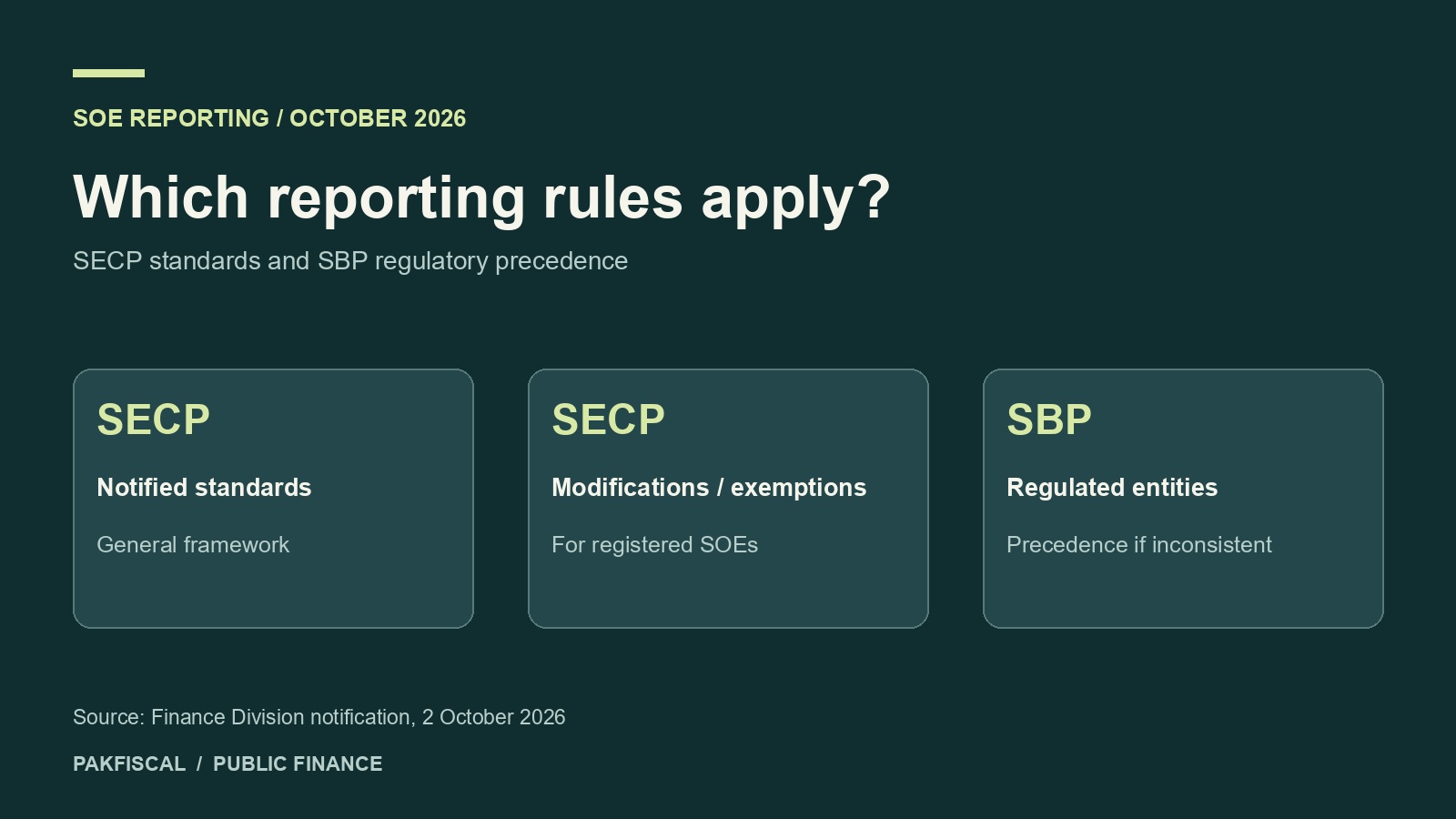
Pakistan’s Finance Division has issued a notification dated 2 October 2026 replacing paragraph 31 of the State-Owned Enterprises Ownership and Management Policy, 2023. The amendment clarifies the financial-reporting framework applicable to SOEs and the treatment of regulator-specific rules.
Which reporting framework applies?
For the SOEs Act, 2023, the amendment defines International Financial Reporting Standards by reference to the financial-reporting standards notified by SECP under section 225 of the Companies Act, 2017.
For entities regulated by SBP, its statutory reporting framework under the Banking Companies Ordinance, 1962 takes precedence wherever there is inconsistency. The notification also preserves SBP’s statutory powers and instructions.
Exemptions and statutory enterprises
SECP modifications or exemptions for companies generally also apply to SOEs registered with SECP under the Companies Act, 2017. Finance Division must consult the Auditor General on a detailed financial-management framework for statutory SOEs. Internal-audit procedures remain required under sections 19 and 20 of the SOEs Act.
Why the distinction matters
For readers of SOE accounts, the practical question is which framework an entity actually used. Two sets of accounts can describe similar businesses while applying different regulatory requirements. Comparison is more useful when the reader checks the accounting-policy notes and the basis of preparation before drawing conclusions from headline balances.
The clarification also matters for public-finance analysis. A reporting rule can affect how a financial position is presented, but that does not by itself establish a change in the underlying cash position or the fiscal support an enterprise requires. Any claim of improved performance needs evidence from the accounts and operating results.
For boards and finance teams, the useful starting point is to establish the entity’s legal form and regulator, identify the notified standards and applicable exemptions, and document the reporting basis consistently. These are analytical implications of the amendment rather than additional requirements introduced by this article.
The notification does not set out a new calendar deadline for IFRS adoption. Its immediate subject is the applicable framework and regulatory precedence; it should not be reported as a blanket, exception-free conversion of every SOE to an identical set of accounting rules.